
Free Webinar
The Heart of Quality: Interaction Data as Quality Systems Evolve
Join us October 14 at 1:00pm ET
The Heart of Quality: Interaction Data as Quality Systems Evolve
Join us October 14 at 1:00pm ET
Every state’s quality system is designed to answer an important question: is a program providing high-quality care and learning experiences for children?
Yet quality is a moving target — in how it’s defined, how it’s measured, how it’s communicated, what it means for children in the classroom. As states evolve their approaches – some using rating systems and others emphasizing continuous quality improvement – understanding the indicators that matter most has never been more important.
In this webinar, we’ll explore how state quality systems are evolving to define, measure and support quality more meaningfully – and what those changes mean. We’ll examine how conversational turns, a key indicator of quality in early childhood settings, can provide actionable insights that drive meaningful improvements in teaching and learning.
We will also share LENA research that demonstrates how interaction data can help programs at every rating level – and can especially help programs early in their improvement journey or working to raise their quality level.
This critical conversation for state leaders, program directors, and quality improvement specialists will cover:
- How programs with the greatest opportunities for growth often see the biggest gains in conversational turns
- Why even the strongest-performing programs continue to find opportunities for growth and improvement
- What “high quality” means as a benchmark for everyday experiences
- How a strong connection between interaction data and quality can drive states’ emphasis on continuous improvement.
Every state’s quality system is designed to answer an important question: is a program providing high-quality care and learning experiences for children?
Yet quality is a moving target — in how it’s defined, how it’s measured, how it’s communicated, what it means for children in the classroom. As states evolve their approaches – some using rating systems and others emphasizing continuous quality improvement – understanding the indicators that matter most has never been more important.
In this webinar, we’ll explore how state quality systems are evolving to define, measure and support quality more meaningfully – and what those changes mean. We’ll examine how conversational turns, a key indicator of quality in early childhood settings, can provide actionable insights that drive meaningful improvements in teaching and learning.
We will also share LENA research that demonstrates how interaction data can help programs at every rating level – and can especially help programs early in their improvement journey or working to raise their quality level.
This critical conversation for state leaders, program directors, and quality improvement specialists will cover:
- How programs with the greatest opportunities for growth often see the biggest gains in conversational turns
- Why even the strongest-performing programs continue to find opportunities for growth and improvement
- What “high quality” means as a benchmark for everyday experiences
- How a strong connection between interaction data and quality can drive states’ emphasis on continuous improvement.
Meet Our Panel
Wendy Simmons
Project Director, State Services, BUILD Initiative
Sarah Neville-Morgan
Assistant State Superintendent, Division of Early Childhood, Maryland State Department of Education
Maegan Lokteff
Executive Director, Early Childhood Council Leadership Alliance (Colorado)
Jill Gilkerson
Chief Research and Evaluation Officer, LENA
Sign up for the Webinar
Share With Your Colleagues
Resources to Support Quality Improvement
Redefining Quality in Early Childhood: From Checklists to Conversations
The very definition of quality in early childhood education has evolved. Just about everyone agrees: There’s one key factor driving child outcomes.
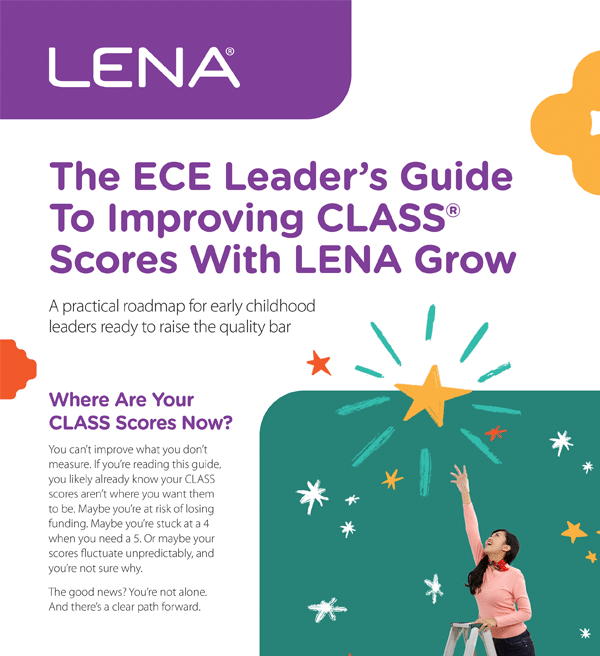
The ECE Leader’s Guide To Improving CLASS® Scores With LENA Grow
You can’t improve what you don’t measure. If you’re reading this guide, you likely already know your CLASS scores aren’t where you want them to be. The good news? You’re not alone. And there’s a clear path forward.
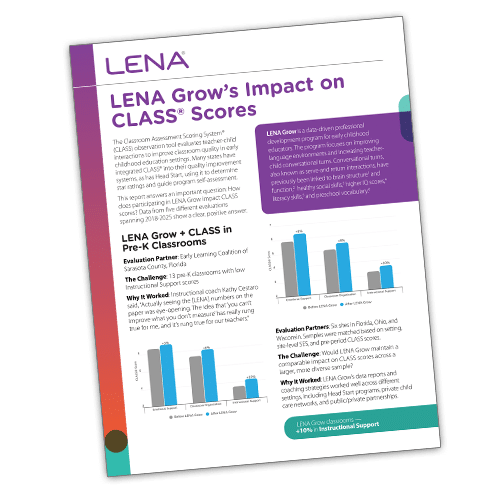
LENA Grow’s Impact on CLASS® Scores
How does participating in LENA Grow impact CLASS scores? Data from five different evaluations spanning 2018-2025 show a clear, positive answer.