

Create the Classroom
Every Child Deserves
One in eight children in early childhood classrooms get almost no interactive talk.
Even in classrooms full of noise and activity. We call it language isolation. But what if language isolation — like so many of the biggest challenges facing early childhood educators today — can be improved by improving the language environment?
Free Webinar:
What is a language environment? Making Space for Every Child’s Voice
March 5 at 1:00pm ET
Our upcoming webinar reveals the hidden crisis of language isolation and shows how interaction-focused language environments drive child outcomes. The conversation will feature:
- How a learning environment full of interactions can impact language isolation and other challenges in early childhood
- Stories from educators who’ve made LENA-inspired changes to enrich their language environment
- Key takeaways on how data-driven feedback empowers educators to shift daily practice, strengthen classroom culture, and support consistent, meaningful interactions
Together, we’ll explore practical ideas for increasing teacher-child interactions to improve outcomes for children and educators alike.
Meet Our Panel
Maisah J. Williams-Foote
Amy Schmidtke
Director of Educational Practice, Buffett Early Childhood Institute; Editor of NAEYC’s new textbook The Intentional Teacher
Farima Nemat
Franchisee, Primrose School of Littleton, CO
Shasta Pentecost
Dawson Education Cooperative Early Childhood Local Lead
Sign up for the Webinar
Share With Your Colleagues
Resources to Support ECE Educators
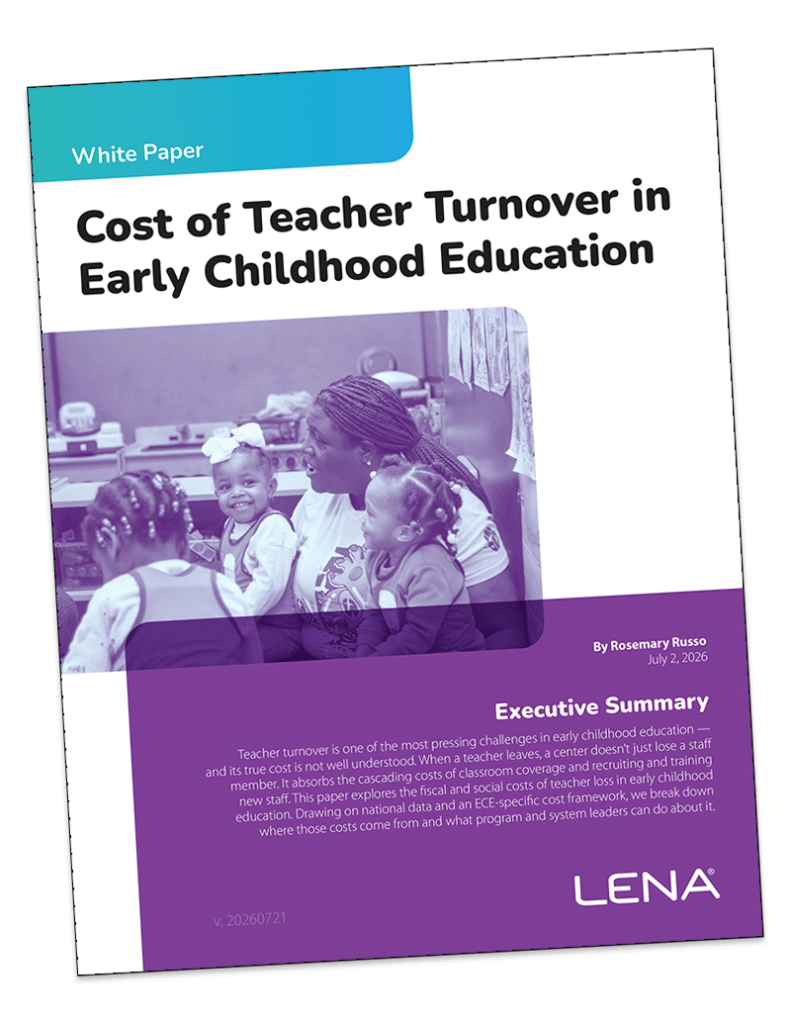
Cost of Teacher Turnover in Early Childhood Education
Drawing on national data and an ECE-specific cost framework, we break down
where the costs of teacher turnover come from and what program and system leaders can do about it.

Help From Day One: What New Teachers Actually Need to Stay and Thrive
Children need teachers to stay. So what can we do from a teacher’s very first day to help them stay and thrive? Find out!
“The Proof Is in the Numbers”: Maria De La Rosa on Language Development and 35 Years of Never Stopping
Thirty-five years is a long time to give yourself to any work. Long enough that you might think you’ve seen it all. But Maria De La Rosa is still curious.