A mom is crying in front of her daughter’s teacher.
Not from worry. From relief.
For months, she’d watched her little girl communicate the only way she knew how — a finger pointed at what she wanted, nothing more. No words. No back-and-forth. Just that finger, and silence. Every parent in that situation carries a weight they don’t always say out loud. Is something wrong? Will she catch up? Will other kids understand her? Will I?
But now the teacher is showing her a LENA Grow report. It tracks how much her daughter talked back and forth with teachers at school the day before. And the numbers tell a beautiful story.
One the mom wasn’t expecting.
Her daughter isn’t just talking. She’s conversing. And now her numbers match the other children in the class. The pointing is nearly gone. In its place, a voice.
The weight lifts. The tears come.
For the teacher, Maria De La Rosa, it’s a moment she won’t forget. And it’s one she attributes to LENA Grow.
35 Years, One Calling
Maria De La Rosa is a child care professional at Rodney B. Cox Elementary School in Pasco County, Fla. She works with toddlers and preschoolers — mostly two-year-olds, some threes — in a community with many Spanish-speaking families.
While it’s her first year at Rodney B. Cox Elementary, Maria has been working in early childhood education for 35 years.
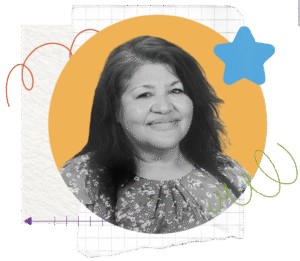
It started when she was 16, volunteering at a child care center over the summer. She never left. “It never felt like a job,” she says. “It felt like I was there playing. Where else are you going to get a chance to get paid to basically play — which is how children learn.”
She calls it her dream job.
Now, years after she first started in the profession, LENA Grow gave her something new to hold onto.
LENA Grow is a job-embedded, evidence-based professional development program. It’s focused on increasing conversational turns, a key marker for quality in early childhood programs, for children from birth through five.
Maria’s story shows us why it’s so important to invest in high quality professional development for early childhood educators.
Two Parts of the Same Story
Creating a Bridge for Bilingual Children
Cox Elementary serves a community with many Hispanic families. For the children in Maria’s classroom, hearing Spanish is a bridge.
“It’s like an extension of our classroom into their home,” she says. “They get to hear what they hear at home. We can connect with them a lot better, and they feel safe.”
That safety matters more than most people realize. For children who are dual language learners, feeling seen and understood is what opens the door to communication. A child who feels safe will try, take more risks with language, and share their voice.
But research shows that, in early childhood settings, dual language learners are four times more likely to experience language isolation than their peers.
Maria’s bilingualism closes that distance.
When Children Are Quiet
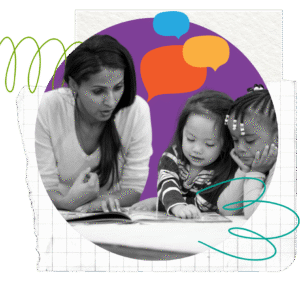
Some of the children in Maria’s classroom arrive as non-talkers. Like the little girl at the beginning.
Maybe they’re quiet because they’re still finding their footing in a new language. Or maybe they’re quiet for other reasons. Either way, they’re missing out on the back-and-forth conversations that build language, connection, and confidence.
For dual language learners and non-talkers alike, what every child needs is more responsive, intentional conversation. That’s exactly what LENA Grow is built to increase, for every child, in any language.
“How Is This Going to Work?”
When LENA Grow came to Cox Elementary, Maria wasn’t sure what to think.
It worked, though.
Not all at once, but much more quickly than Maria anticipated.
Even after 35 years of experience, LENA Grow showed Maria where more was possible. The reports tracked how many back-and-forth exchanges — what LENA calls conversational turns — each child experienced throughout the day. Maria saw the numbers. And she started making small changes in her day.
She started planning differently. Lessons became more intentional. She planned for more language-rich activities and asked more open-ended questions.
Those children who never spoke? “We can’t keep them quiet,” Maria says. “They are just little ‘Gabbys’ in the classroom.”
“A Tool I Never Knew I Needed”
Throughout her career, Maria has seen children grow. She’s celebrated milestones. She’s felt the quiet satisfaction of watching a quiet child finally open up.
But she’d never seen it like this — documented, concrete, right there the very next day.

“I think it’s just instant gratification when you see the report the next day,” she says. “It helps us push even more. We can get these kids to higher numbers. I know we can, and we have.”
That motivation is a huge deal. LENA research shows that teachers who participated in LENA Grow were twice as likely to still be in their roles six months later than those who did not. Ninety percent reported increased confidence. Eighty-eight percent reported higher job satisfaction. “I think it’s a great tool that I never knew I needed,” Maria says. “After 35 years, it’s something that’s different, but it works.”
“Slow Down”
Her advice to teachers new to LENA Grow is not to be so quick to answer for children when they don’t answer questions right away. Give them the opportunity to take the lead in conversations, she says, even if it’s not at the pace you’re used to.
The LENA Grow framework is built on that pause. Wait. Let the child try. Scaffold. Add a word or phrase. Try again tomorrow.
She sees it as a push in both directions. LENA Grow motivates teachers. And motivated teachers motivate children.
Stay Curious
Thirty-five years is a long time to give yourself to any work. Long enough that you might think you’ve seen it all. But Maria De La Rosa is still curious. Still asking what’s possible for the children in front of her. And in her first year with LENA Grow, Maria found what she didn’t know she’d been missing.
Language development in early childhood doesn’t happen by accident. It happens when teachers have the tools, the data, and the support to be intentional in every single interaction.
The proof, Maria will tell you, is in the numbers.
Want to see what LENA Grow looks like in action? Learn more here.