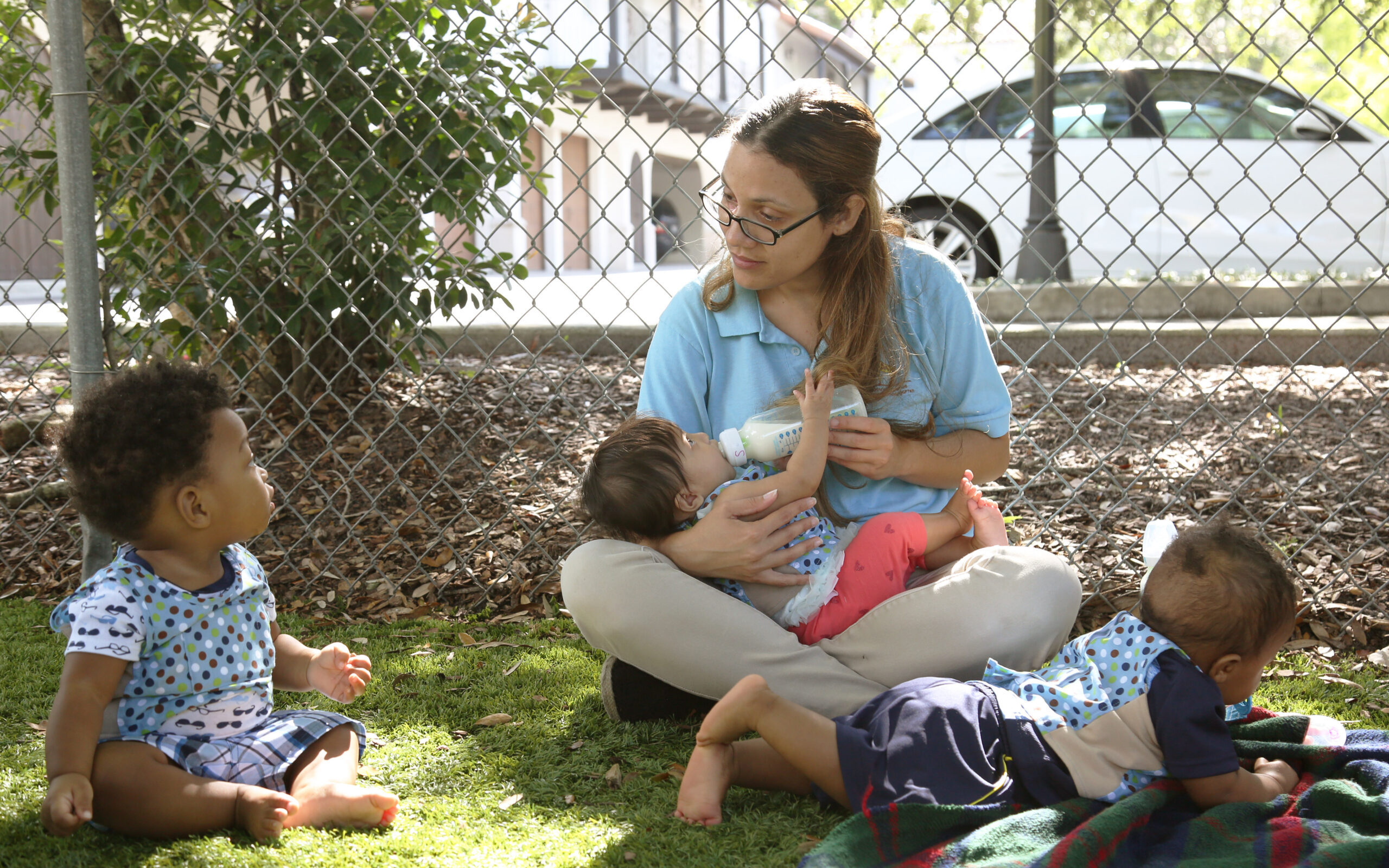
Outdoor time is magical for children! Full of curiosity and discovery. New sights, sounds, and experiences. New opportunities for imaginative play. And — what we’re talking about here — full of opportunities for conversation. In this guide, you’ll find simple, practical ways to turn outdoor moments into conversations with infants, toddlers, and preschoolers. (Did we really just say “conversations with infants”? Yes! More on that in a moment.) No special tools or toys needed. Just the tips, and the time you’re already spending outside.
As Amy Schmidtke, Director of Educational Practice at the Buffett Early Childhood Institute, puts it: “These times really provide natural opportunities for conversation. It kind of takes the pressure off a little bit — these are moments when children are already interacting.”
What Is a Conversational Turn?
A conversational turn happens when an adult and a child communicate vocally back and forth A baby coos. You coo back. That’s a turn. A toddler points at a puddle. You say, “puddle!” They attempt to repeat the word “puddle.” That’s a turn. These small exchanges add up. And research shows they have a big impact on language, learning, and development.
Outside, children are already noticing, pointing, and reacting to the world around them. When adults respond, those moments become opportunities for conversation.
Pick one or two tips from each section to try each time you are outside with your infant, toddler, or preschooler! All of the tips in this guide can be found in our printable resource “The 14 Talking Tips” linked here!
Look, Listen, Respond: Talking With Your Infant Outside
Long before a baby says a single word, they are paying close attention to the people around them. They study your face. They track your voice. They notice when you respond.
Outside, there is so much to notice together. A gust of wind. A dog barking in the distance. Grass under bare feet (or bare knees, for the crawlers among us). These sometimes-short moments are full of possibility.
Tips to try:
- Tune in and respond.
- Wait for their response.
- Imitate them and add words.
- Make faces, use gestures.
Here’s an Example!
Talking about what you notice on a walk with them in a stroller or carrier or while they’re lying on a blanket in the grass helps babies connect words to the world. You don’t need a script. Just follow their gaze.
For infants: Look where they look. “Dog! Do you hear it?” Then wait for a response. A coo, grunt, or squeal. That’s their turn. Respond to it through imitation, repetition, or adding on. “Dogs go ‘ruff ruff’!”
Follow, Name, and Add: Talking With Toddlers Outside
All kinds of things spark a toddler’s interest! Maybe it’s a rock they just found, a shadow moving on the ground, or even a crack in the sidewalk. That is an invitation for you to engage with them.
When you follow their lead and name what they find, new words stick because the word came with an intentional moment attached to it.
You don’t need a playground for this. A patch of grass works. Walking across a parking lot headed into a store works. Waiting outside the school pickup or dropoff line works. Toddlers will find something worth talking about almost anywhere.
Tips to try:
- Comment on what they’re doing or looking at.
- Name things that they’re interested in.
- Repeat and add to what they say and do.
- Follow their lead.
Here’s an Example!
Naming what a toddler finds — and adding just one more word — helps vocabulary grow in a way that feels natural.
For toddlers: Your child picks up a stick. You comment, “Stick! That’s a long stick.” They wave it. “You’re waving it! Hi, stick!” Wait. See what comes next. Add to it.
Take Turns, Encourage Them, and Be Silly: Talking With Preschoolers Outside
Preschoolers have a lot to say. And outside, there’s a lot to say about everything!
They want to explain things, negotiate things, wonder out loud about things.
The best conversations with preschoolers often start with an observation or question. And then waiting for their response.
Tips to try:
- Talk about what you’re doing and thinking.
- Take turns — don’t do all the talking.
- Encourage them, be positive.
- Be silly! Relax and have fun.
Here’s an Example!
Back-and-forth conversation at this age builds reasoning, vocabulary, emotional intelligence, literacy, and social skills.
For preschoolers: A child is staring up at the sky. “That cloud looks like a big heart. What does it look like to you?” Stop. Wait. Let them look. Let them tell you what they see. Make it a moment of wondering together!
Walking from the car to the store, waiting outside a sibling’s sports practice, sitting on the front steps. Any of these work. “I wonder what that sound is. What do you think it is?” Then wait. See where they take it.
Outside Already Has Everything You Need
That’s true in child care. And it’s true at home too.
The conversations don’t have to be long. They don’t have to be planned. Outside, children are already curious. Ready to talk or already talking. Being there with them and responding to them helps build and grow responsive relationships.
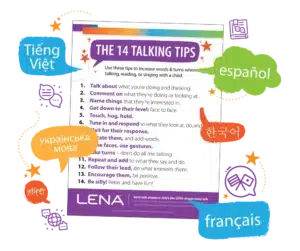
Ready to keep these tips close?
Download LENA’s free 14 Talking Tips sheet here. Print it, post it, or pass it along. And if you’re an early childhood educator, learn more about how LENA Grow puts this kind of intentional practice at the center of your professional development.