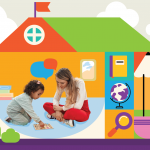
Most children experience hundreds of thousands of verbal interactions with adults by the time they turn 6.
Researchers have found that how many serve and return interactions children experience is directly related to how their brains develop. And how well they do in school. In fact, these serve and return interactions — we call them conversational turns — are linked to everything from vocabulary skills to reading ability in later years. It even impacts their IQ score!
So, for an early childhood education professional, understanding how to create supportive and engaging language environments is so important!
But what is a “language environment,” anyway?
What Makes Up a Supportive Language Environment?
When we talk about a “language environment,” we’re actually talking about two important pieces that work together. One is the physical space and how that’s organized. The second piece is how adults interact with children in that space. Both parts help children learn language naturally throughout the day.
“The language environment is a place that promotes children’s exploration and curiosity through physical, social, emotional, and sensory components,” says Eva Jenkins, an early childhood advocate and member of the LENA Community Advisory Board. “Everyone that shares the space communicates equally and often.”
The Human Aspect of Early Literacy and Early Language Environments
While the physical classroom environment is important, the invisible language environment we create is way more so! It should be one where children feel safe to express themselves, take risks with language, and engage in meaningful communication.
Maisah Williams-Foote is President Elect of the Georgia Association of Education of Young Children (GAEYC) and has many years of experience in the early childhood education field. She emphasizes: “An effective language environment is interactive, responsive, and culturally inclusive, integrating spoken and written language in meaningful ways that nurture communication, literacy, and cognitive development.”
Try to create an environment where:
- All languages are valued and celebrated. Provide age-appropriate books in different languages!
- Children feel confident to share their ideas in class. Ask questions about their ideas and share them with the group.
- Every child’s voice matters, from the quietest to the most talkative. Carve out time to talk one-on-one with the quieter children.
- Peers learn from and encourage each other. Clap, fist bump, high five, pat each other on the back and encourage children to do the same!
Structure your day to include:
- Small group conversations where every child can participate
- Times for storytelling and sharing personal experiences
- Opportunities for children to be both speakers and listeners
- Quiet moments for processing and thinking
- Natural times for back-and-forth conversations between children
- Chances for children to lead discussions and activities
These human elements, over and above the physical ones, work together to create an environment where language and literacy development happen naturally.
Creating Early Learning Environments for Language and Early Literacy
The way you organize your classroom or learning space can make a big difference in how much children talk and learn. The physical space should support early literacy, language development, and positive interactions!
However, decorations and play area creation should be strategic. Walls that are too busy or overcrowded hinder children’s early literacy and language development. A cluttered play area may cause overwhelm. This prevents children from engaging in play and conversations.
Place materials like books and toys at the child’s eye level so they can reach them on their own! This helps them start conversations naturally.
Easy Tips and Tricks
Fill your space with materials that support language development and early literacy. Maisah provides some excellent tips to get kids talking:
- Label everyday items with both pictures and words. Children can help!
- Put up interactive word walls that children can touch and use.
- Display children’s own work with their words and stories.
- Add real-world items like menus, maps, and magazines to play areas.
- Stock your reading area with books that show different cultures and languages.
- Create signs and labels for all the languages represented in your classroom.
Keep materials fresh and exciting by changing them often. When children see new things in their environment, they ask questions and learn new words.
For example, adding clothes and menus to your pretend play area can turn it into a busy restaurant or clothing store where children practice new words and take turns talking with friends.
Remember: even the best-designed space only works when teachers and caregivers know how to use it effectively.

“Language communicates needs, information, and feelings and may be expressed verbally, as well as through body language and sign language. An early language environment nurtures and values every opportunity for conversation.”
—Eva JenkinsPutting It All Together
Creating a language-rich environment might feel overwhelming at first. Start small! Choose one area of your space to enhance each week and add one new language-building routine to your day. Remember that quality matters more than quantity.
And your efforts do make an impact. We promise!
Every word, every conversation, and every language-rich space you create helps build a stronger future for the children in your care. The steps you take today — from setting up your space to building a language-positive culture — make a real difference in children’s early language development.