Some of the richest conversational turns of a child’s day happen in the most unexpected places. Almost any moment where a child and adult are together and sharing attention can become one.
A conversational turn, also called a “serve and return interaction,” is a back-and-forth vocal exchange between an adult and a young child. Specifically, conversational turns involve children aged birth-to-five.
Children are born ready to learn language. Babies lock eyes with you, coo or babble , and reach toward what catches their attention. Toddlers point at things they notice. Some grunt, babble or gesture, and some will narrate an entire sock drawer. Preschoolers will start a whole conversation about a bug on the sidewalk. If they’re not talking yet, they may make other sounds to show their interest or excitement about the world around them.
The question isn’t whether there’s something to talk about. There always is. The question is how we can use every moment we’re already in.
Where Can We Talk With Children During Daily Routines?
Check out these four examples!
What’s in That Cart? (More Than Groceries.)
The front seat of a grocery cart — the child is almost at eye level with you, has nowhere to go, and is surrounded by tons of textures, smells, and colors. They are already paying attention. They just need a partner.
The produce section alone is a vocabulary goldmine. Bumpy. Smooth. Cold. Heavy. There are tons of sensory words right there at arm’s reach.
Try this: Hand them something before it goes into the cart.
- With a baby or young toddler: “That’s a banana. It’s smooth and yellow. Do you think it is yummy or yucky?”
- With a preschooler: “This apple is green and this one is red. Which one do you think will taste better?”
Then remember to ask again when you get home. Children light up when you follow through.
→ The 14 Talking Tips include strategies for following the child’s lead and describing what you’re experiencing together — both work perfectly in any store aisle.
Getting Out the Door (and Into a Conversation)
Shoes. Jacket. Lovey. The moment before leaving the house is often a sprint. But somewhere in that sprint, there is a child still figuring out which arm goes in which sleeve. Which means they are standing still, right next to you, for at least a solid minute.

From the front door to the car or bus can be a whole conversational adventure!
Try this: While you’re helping with the the jacket, backpack, or getting baby in a car seat or carrier, ask a question or narrate what you’re doing. For example:
- With a baby or young toddler: “Here comes your jacket. First the right arm, now the left one. There you go!”
- With a preschooler: While helping with a zipper or tying shoes, try asking “What are you most excited about today?”
For children who aren’t talking yet, narrating that time between leaving the house and getting buckled into the car seat or boarding the bus is also a good way to initiate back and forth conversation. Remember, coos, squeals, and attempts at language count as a response!
→ Talking Tips for Transitions breaks down how to make in-between moments count.
Bath Time (Just the Two of You)
Warm water, a washcloth, maybe even some bubbles or bath toys. Bath time puts a child and adult together in the same small space with very little else going on. Just the two of you.
Children are often more relaxed and playful during bath time than at almost any other moment in the day. That makes it a natural place for the kind of calm, unhurried back-and-forth that builds language.
Try this: Narrate what you see and do. Describing the sensations and actions of bath time helps children build vocabulary in a low-pressure, joyful setting.
- With a baby or young toddler: “The water is warm! I’m washing your little toes. One, two, three, four, five.”
- With a preschooler: “You’re pouring the water into the cup. What do you think will happen if you pour it on the washcloth?”
Splashes, squeals, and reaching toward objects are all forms of communication. Respond to whatever they offer.
→ Turn-Taking With Non-talkers gives you strategies for building back-and-forth conversation with children who aren’t yet using words.
The Wait Is Actually a Window of Opportunity
The pediatrician’s waiting room. A restaurant table before the food comes. The school dropoff line. If you pick up your infant, toddler, or preschooler first and have to pick up an older child at school, the pickup line may also be a good time to start conversations.
Waiting is one of the only times in a busy family’s day when there is genuinely nowhere else to be. The child is right there. Nothing is pulling either of you away. And children are so often curious about their surroundings. They just need someone to be curious with them.
Try this:
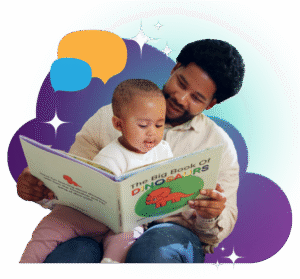
- With a baby or young toddler: Reading books you bring or ones that are in the waiting room, singing songs, or playing “Peek-A-Boo” are great ways to have conversations!
- With a preschooler: “I Spy” is a great game for times like these. Or “How many things in this room are the color blue? Let’s count them together.” If there are books available, waiting time might be a good time to read together!
Conversation Starters for Feelings and Emotions offer ready-made prompts that work anywhere, no prep needed.
These Moments Add Up
LENA’s research shows that more interactions lead to better outcomes for children. So every interaction counts — not just from place to place, but moment to moment throughout the day. And every one of those moments counts. Even the car seat, the wait times, running errands, and doing household chores.
Mundane moments turn into magical moments of connection that support children’s brain development. Plus, it makes those moments more fun for you both!
If you want to learn more about how to create more conversation and connection with young children, visit our “Tip Sheets” printable resource page here!