A familiar song is playing in a room full of wiggly children ready to move to the beat. Ready for fun and giggles.
Maybe it’s a routine tune (Head, Shoulders, Knees, and Toes, anyone?). Maybe it’s not.
Either way, music is a powerful “instrument” for fostering early literacy, language development, vocabulary acquisition, and reading readiness in children through rhythm, rhyme, and repetition.
Used with intention, music is one of the most natural tools you have for sparking the kind of interactions that build brains. When a child fills in a missing lyric, echoes a phrase back to you, or talks with you about an instrument, you are creating responsive interactions.
What are those interactions? At LENA, we call them conversational turns. And they’re one of the most valuable things you can offer a young child.
Why Back-and-Forth Matters
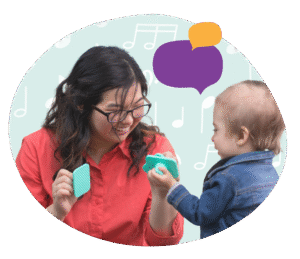
A conversational turn is simple. An adult says something, and a child responds, or a child says something, and an adult responds. Even a baby’s coo counts when you talk back.
These back-and-forth exchanges are linked to stronger language development, better early literacy skills, and healthier brain development overall. Children don’t just need to hear words. They need a response. That’s what builds brain connections that support reading and long-term learning.
But talking isn’t the only thing that creates conversational turns. Music does as well!
What Music Does for Developing Brains
Here’s what happens when children engage with music:
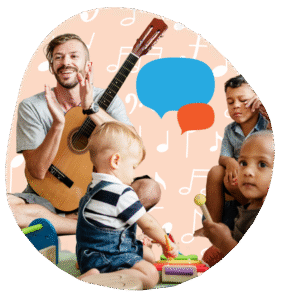
Rhythm: Rhythmic movement and language trains the brain to detect patterns. That’s the same skill that underlies reading. So, clapping and tapping aren’t just fun. They’re foundational.
Repetition: Children who want to sing the same song over and over and over? That’s actually the brain doing exactly what it should. Repetition is one way to build vocabulary. When children hear the same words in the same song again and again, their brains are strengthening connections with every single round.
Melody: Melody makes language stick. Children remember words in songs far more easily than spoken sentences. Think about how quickly a child memorizes lyrics. Melodies improve the ability to recognize and use the spoken parts of sentences and words, including syllables, rhymes, and individual sounds.
Three Music Strategies That Invite More Conversation
Our friends at Kindermusik have spent decades helping educators use music to support early childhood development. Their approach is intentional, research-based, and built on a simple idea: Music is a vehicle for learning, not a break from it. Here are three of their favorite strategies for turning musical moments into conversational ones.
1. Fill in the Lyric
Sing a familiar song and leave a word out. Then wait.
Start simple: “Twinkle, Twinkle Little ___.” Then try something harder: “Twinkle, Twinkle _____ _____. How I _____ what you are.”
That pause is doing real work. It tells children it’s their turn. For children who don’t often initiate, a familiar song creates the safety they may feel like they need to step in and try. Try Kindermusik’s “Twinkle, Twinkle” interactive song below!
Every time they fill in the blank and you respond, it’s a conversational turn!
2. Call and Response
Call-and-response songs give children a structure to follow. Songs like “Down by the Bay,” “Boom Chicka Boom,” or Kindermusik’s “Flea, Fly, Mosquito!” tell children exactly when it’s their turn. That predictability builds confidence. Before long, children start competing for the chance to lead.
Watch a perfect example of this below!
3. Instrument Exploration
Put on “All Around the Kitchen.” (Stream it for free on the Kindermusik App, or find it on most music streaming platforms.) Grab instruments or pull out the pots and wooden spoons. Play freely together for a few minutes.
Ask open-ended questions to support children in sharing ideas for how to play the instruments or what it was like to play them. For example, ask “What did you play?” or “What sounds did you make?” Repeat this until all children who want to go have had a chance.
Open-ended questions keep the conversation going. You can find some more free printable resources with open-ended question options on our“Tip Sheets” page!
None of these strategies require extra time or extra prep. They work inside what you’re already doing. That’s both the beauty and the power of combining interactions and music.
It’s Good for You, Too
Another reason music is important in the classroom? When teachers are having fun, children feel it. Music brings lightness to a room that makes the connection feel easy and natural. Those joyful, musical moments aren’t just good for children’s early language and literacy development. They’re good for the people who show up every day to create them.
“We start with song to form bonds, knowledge, and healing…communication is key and children respond better to song than anything else.” — Jason Hale, Community Action Council Lexington Fayette Bourbon County
Remember
Children who experience more conversational turns show stronger language development, better early literacy skills, and greater readiness for school. Music helps make those moments happen more often. And more often is exactly what children need.
So, pick one strategy and give it a go. See what happens.
If you want to see the impact those conversations are having in your classroom, explore LENA Grow, the professional development program that measures and improves the teacher-child interactions that matter most.
For more music activities that support early childhood development, explore everything Kindermusik has to offer.