Walk into a busy child care or preschool classroom and your first impression might be that a lot is happening. Unless it’s nap time, children are building and talking. Teachers are moving. It feels productive. It feels alive.
But is every child in that room actually being heard?
That question drove a hour of rich conversation with four early childhood education professionals in our most recent webinar, “What Is a Language Environment? Making Space for Every Child’s Voice.” They talked about what a language environment really is, how language isolation can creep in, and what changes when teachers get clear data about what’s actually happening in their classrooms.
Moderating the conversation was Maisah Williams-Foote, Director of Organizational Effectiveness at the Council for Professional Recognition and a member of LENA’s Community Advisory Board. Joining her were:
- Amy Schmidtke, Director of Educational Practice at the Buffett Early Childhood Institute and editor of The Intentional Teacher
- Shasta Pentecost, Local Lead at Dawson Educational Community Cooperative Early Childhood in Arkansas
- Farima Nemat, franchisee at Primrose School of Littleton, Colorado
What Is a Language-Rich Early Childhood Classroom?
A “language-rich environment” isn’t just busy, noisy, active. More than a room full of chatter.
The most important part of a classroom language environment is the intentional and responsive communication between teachers and children. The interactions that promote children’s communication, language development, and relationships. And this form of communication happens through frequent, responsive interactions.
Amy made the distinction right away.
“A classroom can be loud and still not be language-rich…Are adults interacting with children with warmth and intention? Building this environment, it takes intentionality.”
She also noted that a strong language environment isn’t a separate goal sitting alongside literacy or social-emotional development. It’s the foundation everything else builds on.
So, what does quality actually look like? It looks like genuine interest in what a child is communicating. Warmth, eye contact, and nonverbal cues. Quality looks like waiting for children to respond to open-ended questions and a teacher showing that child that his or her voice matters. It looks like being present! Amy also mentioned that high-quality language environments also include children talking with each other, not just with the teacher.
Everything changes in a classroom when this happens!
“It just becomes kind of like a garden of language that is bustling with life. When you feel your voice matters, you’re going to use it so much more.” – Amy Schmidtke
Language Isolation Shows Up in Surprising Places
Right now, about one in eight children in early childhood classrooms experiences language isolation. LENA defines language isolation as fewer than five conversational turns per hour, for most of the day. That’s a significant amount of time without the responsive connection children need to grow.
And, surprisingly, language isolation doesn’t always look the way we expect.
Sometimes it happens to the quiet child. The one who follows directions, doesn’t cause disruption, and plays independently without ever asking for help. Shasta sees this often. She said, “A lot of times, as teachers, we get so busy talking and not giving chances for kids to answer questions.” It’s more instructional than conversational.
But open-ended questions are what prompts more back-and-forth between adults and children.
Farima has seen the other end of the spectrum. The very talkative child can also be in language isolation. When a child talks constantly, chatters, sings, complains. When they keep going and going, sometimes they get one or two-word responses. It looks like engagement, but the conversation never really deepens.
“At times the child is saying a lot of things because they feel they’re not actually being heard.” – Farima Nemat
Farima also described multilingual children who arrive in classrooms speaking only their heritage language. One child at her school came in speaking only Russian. This child was scared and would shut down and cry. Not because the teachers weren’t warm and loving or because they weren’t trying to connect with the child. Even caring teachers struggle to connect without a shared language.
One powerful point from Maisah: “Proximity does not always equal engagement.”
A teacher can be sitting right next to a child and still not be truly with them. That space — between being near and being present — is often exactly where language isolation lives.
Importantly, the panelists were clear: This isn’t a teacher failure. It’s a challenge that emerges from busy, complex environments where many needs compete for attention at once.
Mealtimes and Outdoor Play: Two Hidden Opportunities
When Shasta’s program started using LENA Grow, two parts of the day had significantly fewer conversations than the rest: mealtimes and outdoor play.
Teachers manage a lot during lunch and snack time — spills, dishes, children who need help with their food. The process of getting through the meal takes over, and conversation falls away. Regarding outdoor play, Shasta admitted, “As a teacher, outside was kind of my time to take some deep breaths and, you know, get my thoughts.” She wasn’t the only one. Maisah shared the same. Keeping everyone safe was once her only focus outdoors.
But both moments hold so much potential for conversational turns.
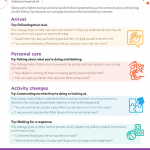
Mealtimes, Shasta pointed out, are natural conversation spaces. Think about when families talk most — at meal times. The same energy belongs in the classroom. Her team created placemats and mealtime recipe cards with conversation starters, giving teachers something concrete to lean on.
Outside time also shifted. It’s an extension of the classroom. Shasta started coaching teachers to approach small groups during play — to ask what children were doing, follow their lead, and spark conversations the same way they would inside.
These changes were grounded in data from LENA Grow, which made them feel purposeful rather than overwhelming.
What Happens When Teachers See Their Own Data
Sometimes, data can feel like a grade. And numbers can feel like criticism. But that is not what happened when these teachers saw their numbers in their LENA Grow reports!
For all of the panelists who have used LENA Grow in their programs, data provided clarity. A direction. And that’s exactly what makes data work.
Amy said, “If data feels like evaluation, sometimes people shut down. But if it feels like insight into children’s experiences, people lean in a lot more.”
Insight helps teachers lean in, build momentum, and set goals. They get excited. Our panelists have seen joy come back to their teachers and the classroom. Confidence. And in quality language environments, children start to feel seen. They develop a sense of belonging that shapes how they show up for learning. And how they show up for life.
Children who feel like their voice matters participate more. They take risks. They try harder things. They use more language. Behavior challenges drop because children have the words and the confidence to express what they need. Vocabulary grows. Comprehension grows. Everything that early childhood educators are working toward — literacy, kindergarten readiness, social skills — gets stronger when the language environment gets stronger. And language isolation is prevented from ever happening!
Amy called it magic. And it is. But it is also measurable. The thing that feels like magic is the thing LENA can show you in data — and the thing teachers can build on, week by week, one conversation at a time.