Have you ever walked into a place where everyone already seemed to know each other? Maybe your first day at a new job or a party you were invited to as your friend’s date. People talk across you, not with you. You stand there holding your coffee or drink. Smiling too much and unnaturally. Trying to look like you know what everyone’s talking about, nodding occasionally. You wonder if you should speak — or if anyone would even answer. Does anyone even realize you’re there?
Now imagine feeling that way when you’re three.
A child care or preschool room can feel loud. Chairs scrape. Blocks clack. A song plays in the background. Children move from rug time to snacks to the door for recess. Chattering, laughing.
And still — many children can feel alone. Ignored. Left wondering if anyone even knows they’re there.
In early childhood classrooms, children don’t just need words around them. They need responsive relationships. Teacher-child interactions that say, ‘I hear you. I see you. You belong.’ LENA calls these moments conversational turns.
Research shows that children within the same classroom can have very different experiences of how much interaction they get. And for many children, part of that experience is language isolation.
What Language Isolation Is — and Why It Matters
You may not think that much about the concept of language isolation in early childhood. But it happens. It happens in bright classrooms with art on the walls and a teacher who truly cares. It happens in a child care center with five stars just as easily as one with one or two.
Language isolation means a child gets fewer than five back-and-forth exchanges with an adult per hour for almost the whole day. Forty exchanges per hour is optimal, so this gives you an idea of just how isolated a child in language isolation must feel! A child might get a little interaction at drop-off or departure. But for the rest of the day, the child has very few chances to respond — and even fewer chances to be responded to. They’re verbally isolated.
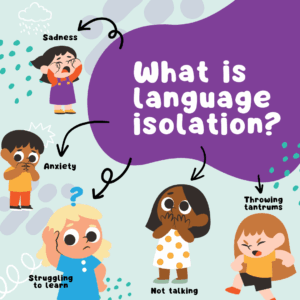
And this is not rare. According to LENA’s analysis of daylong recordings from 33,256 children participating in LENA Grow, 13% experienced language isolation. One in eight children.
Children can sit in a caring early childhood classroom and still miss out on those back-and-forth moments. A room can run smoothly and still leave someone behind. It’s so easy to interact with the children who ask the most, move the most, or need the most right away.
Why does that matter so much? Because conversational turns help build a child’s brain — literally. They help children develop language and literacy skills, manage feelings, and connect with others.
A strong early childhood language environment that keeps children out of language isolation is one where children’s voices are heard — and responded to. It’s full of warm teacher-child interactions that invite them in, again and again.
How Language Isolation Happens in Real Classrooms
Early childhood classrooms move fast. Teachers juggle diaper changes, spills, transitions, and big feelings. Many times — possibly even most — children’s basic needs take priority over conversational turns for early childhood teachers.
The point is, language isolation is not intentional. And it’s not the teacher’s fault.
In a high‑quality early childhood program, you might imagine that every child gets equal, or near equal, attention. But out of eight children in a top‑rated program, one or more might still slip into language isolation simply because it’s in their nature to stay quiet. Or because louder peers pull more adult time.
A quiet child might wait for a turn that never comes as their teacher comforts a crying friend. Timid children may keep to themselves, hoping someone notices the blocks they stacked or the pictures they drew. A dual language learner might watch a teacher lead a group activity from the outside looking in.
When teacher‑child interactions don’t reach every child, even well‑run classrooms can leave someone feeling unseen. With the right data in hand, programs can see this immediately.
A Clearer Picture
Language isolation hides because it doesn’t look dramatic.
Just like the example of adults we mentioned in the beginning. When you’re being left out at a party, when you’re being isolated. It’s likely not intentional. There’s just so many other things going on. People are laughing, singing karaoke, talking about their day. And no one’s been made aware that you’re not being included.
Children aren’t being excluded from adult-child interactions on purpose.
And here’s the thing. Programs don’t have to guess their way out of this.
LENA tracked what happened when teachers got coaching and support through the LENA Grow professional development program. In that same analysis, 58.5% of children who started in language isolation moved out of it by the end of the program.

When teachers strengthen everyday teacher-child interactions, the benefits don’t stop at conversational turns. LENA shares evidence that LENA Grow supports stronger classroom quality, growth in children’s language and literacy skills, progress toward kindergarten readiness, and more teacher confidence and job satisfaction.
When adults build a habit of talking with children consistently and often throughout the day, they learn more than language and literacy. They learn that they belong.
The Kind of Classroom Every Child Deserves
Every child deserves to feel included, heard. Not once or twice a day, but all day long.
LENA’s research suggests early childhood leaders can start by asking questions that data can answer: Which children get the least back-and-forth talk? When do they get missed? What gets in the way for teachers?
The answers shift a classroom from “controlled chaos” to building a language environment where every child gets a real chance to connect with their adult caregiver or teacher.
Those same answers also take pressure off teachers. Instead of guessing, they can focus. Instead of trying to “do more,” they can do what matters most. They can reach all children, so not even one slips through the cracks.
If you’re looking for more information on how to prevent or end language isolation in your early childhood program, we hope you’ll check out LENA Grow and request a free demo!