In early childhood classrooms, mealtime menus are designed thoughtfully. Who, what, when, and why are designed to support the nourishment that young bodies need to grow.
Children’s brains, though, require nourishment beyond calories. Part of this nourishment comes through interaction. Conversational turns between teacher and child that are responsive, relational, and sustained over time. Just like the carbs from lunchtime spaghetti, these moments are absorbed. They don’t work in isolation.
Across the country, LENA Grow partners are using data to reimagine what’s possible during mealtime. They’re influencing not only classroom practice, but policies, schedules, staffing models, and physical environments. These shifts highlight that when LENA Grow influences everyday routines like mealtime, systems begin to see conversational turns as a form of developmental nutrition. Mealtimes become levers for real, lasting change.
Conversational Turns Nourish Young Brains
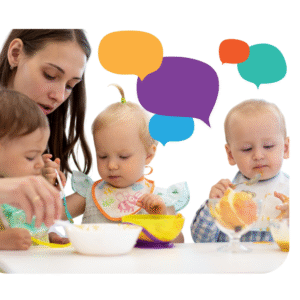
LENA Grow makes the invisible, visible. The program spotlights when conversational turns are happening and when children are going hungry for interaction. The data reveals patterns. And one pattern shows up again and again: Mealtime is rich with potential but unequal in outcomes. Large cafeterias, rigid seating, or loud environments that stifle engagement can all reduce opportunities. Children can be surrounded by noise and not conversation.
The difference isn’t motivation. It’s design. When systems treat interaction like nutrition — something children need regular access to every single day — the question shifts from “Are teachers doing enough?” to “Is the system designed to provide what children need?” When leaders use LENA data to rethink mealtime, they are reducing the burden of “doing more.” Instead, they are reshaping the environment so that high-quality interaction is no longer a chore, but part of the natural flow of a regular day in an early childhood classroom or center.
How Teachers Used Data to Transform Mealtime Interactions
Not every design change requires a full policy overhaul to create a meaningful impact for increasing interactions.
In Pasco County, Fla., teachers noticed something when reviewing LENA reports: Where a child sat during lunch directly influenced how many conversational turns they experienced. Children seated far from adults had significantly fewer interactions. In response, teachers changed seating arrangements so that adults were positioned between tables and children experiencing less interaction were seated closer to them. Because teachers were able to engage with children more effectively and efficiently, conversational turns increased almost immediately.
In Ohio, partners used LENA Grow coaching to support teachers in making intentional, data-informed adjustments during mealtimes. Teachers moved closer to children and created seating charts to reduce language isolation. LENA defines language isolation as fewer than five conversational turns per hour for all but one hour of a child’s day. Teachers began treating interactions as part of the curriculum, not something separate from instruction. One teacher intentionally sat next to children who were experiencing fewer conversational turns. Another began adapting lesson plans and activities based on children’s interests observed during informal moments like meals.
How Mealtime Data Moves From Classrooms to Program Policy
When LENA Grow data spotlights opportunities in daily routines like mealtimes, educators and leaders can immediately act. What begins as a classroom-level insight can become a policy conversation.
In Cherokee County, S.C., LENA data revealed that young children had far fewer interactions when eating lunch in a shared cafeteria with K-5 students compared to eating in their classrooms. Teachers used this data to advocate for a change in practice, successfully shifting 4K meals from the cafeteria to classrooms. The result was a dramatic increase in conversational turns, giving educators greater ease in using mealtime conversation starters and responsive interaction strategies. These schools now have plans to advocate for district-wide change for younger grades.
In Kankakee County, Ill., these same insights are reaching towards the school board level. After identifying lower conversational turns during cafeteria meals for full-day classrooms, leaders used LENA data to support a shift so that all meals would take place in classrooms instead. LENA data clearly helped decision makers listen. For hundreds of children, that decision reshaped their daily language environment. Over time, these shifts changed teacher mindset as much as practice. Improving interactions has ripple effects throughout the day, and LENA data helps teams focus on what is truly working.
Why Mealtime Is a Powerful Early Childhood Systems Lever
Systemic impact is about durability, not just change. When LENA Grow influences decisions about schedules, staffing, room setup, professional development, or daily routines like meals, those changes outlast any single program cycle.

Mealtime is especially powerful because it is:
- Universal – Every child eats every day.
- Routine – It happens consistently across classrooms and programs.
- Relational – It naturally invites conversation and connection.
- Malleable – Small changes in structure can lead to big gains in interaction.
From Ohio to Florida, South Carolina to Illinois, LENA Grow partners are demonstrating that meaningful gains in early talk can come from rethinking everyday routines and examining what already exists. It’s about helping systems ask better questions. Are children consistently receiving the conversational nourishment they need? Are there moments in the day, like meals, where access is uneven? And what changes would make high-quality interaction the default, not the exception?
This matters because systemic impact reduces the burden on individuals by improving the conditions around them instead of asking individual teachers to work harder. When systems begin to see conversational turns as essential nutrients for early brain development, everyday routines take on new meaning. Lunch tables become learning environments. Seating charts become equity tools. And meal time becomes a daily investment in children’s futures.
________________________________________________________________________________________________________________________
LENA’s impact work is supported partially by the W.K. Kellogg Foundation. To learn more about LENA’s three-pronged impact approach, visit our LENA Impact page.
Have ideas? Email impact@lena.org to reach LENA’s Impact team.