Your classroom looks great. It feels great! The reading nook invites children to curl up with a book. Shelves are labeled with pictures and words. You’ve stocked your space with early childhood education resources in multiple languages, and the walls celebrate your children’s own work. You’ve put real thought into this. (We recently explored what makes up a supportive classroom language-rich environment — and if you haven’t read that yet, it’s a great place to start!)
But a language environment isn’t something you build once and walk away from. It’s something you activate. Every routine, every transition, every small moment throughout the day holds potential for the kind of back-and-forth interaction that creates classroom quality. Even the moments that might not feel like they do.
So what exactly do we mean by “language environment”? It’s the combination of your physical space and the responsive relationships that happen within it. The words. The warmth. The back-and-forth conversations — what we call conversational turns — that help children feel heard, connected, and included.
Language-Rich Environments: Your Day Is Full of Language “Hot Spots”
Not every moment in a child’s day carries the same potential for conversational turns. Some routines naturally spark richer vocabulary. Others invite deeper, more personal conversations. And a few create the perfect conditions for those brain-building back-and-forth exchanges.
Once you start looking for them, you’ll find these moments everywhere.
Small Group Time
When you gather just a handful of children together, each child gets more room to speak — and more reason to. Questions land differently in a small group. Children respond with more detail. Vocabulary gets richer because the conversation can go deeper.
Try this: Pop by each center or small group activity and ask one open-ended question. Then pause. Give children five to 10 full seconds to think before you jump in. Children come up with amazing things when they have time to process. Rotate through each center as many times as possible, asking questions that are going to get them talking.
Mealtimes
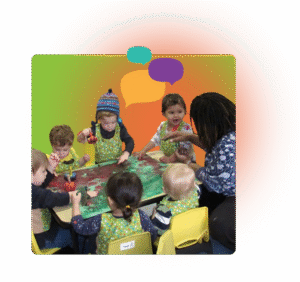
Children are seated. They’re engaged. And for a few precious minutes, they’re (mostly) still. That makes mealtime a great opportunity for conversational turns. Describing food, talking through the steps of a recipe, sharing stories from the weekend. It all counts.
Try this: Pick up a piece of food and wonder out loud: “This apple is SO crunchy! What about yours? Is yours crunchy or soft?” Descriptive language flows naturally when there’s something real to talk about, right there on the plate.
Outdoor Play
Language-rich environments don’t have to exist within a building. Kids move differently outside. They run, dig, climb, splash. And all that movement sparks curiosity — which sparks language. A child who spots a worm on the sidewalk is already primed for a conversation. They just need a partner.
Try this: Become a narrator. Follow a child’s gaze and put words to what they’re noticing. “You found something under that rock! It’s wiggling. What is that?” Nature does the heavy lifting. You just show up and talk about it.
Arrival & Departure
These bookend moments shape a child’s entire day. A warm greeting at drop-off starts the day out right. A personal check-in at pickup gives them a chance to share what they loved about their day. Both are gold mines for connection and conversational turns.
Try this: Greet each child by name and ask a specific question. “What did you do with the puppy this morning?” or “What did you have for breakfast?” Children light up when you talk about what interests them.
Pretend Play
Watch a group of children run a pretend restaurant and you’ll hear some creative vocabulary. Pretend play is where children negotiate roles, solve problems, and practice expressive language — all on their own terms. The imagination does the teaching.
Try this: Drop into their world for a minute. Sit at their “restaurant” and order from the menu. Ask the “chef” how they made the soup. Follow their lead and let the conversation unfold. (Want some ready-made prompts? Download LENA’s “Conversation Cards for Reading and Pretend Play”!)
Transitions
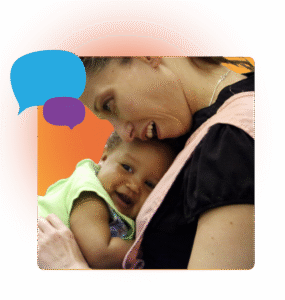
Children in early childhood programs and child care centers experience up to 30 transitions a day! Hand washing. Lining up. Cleaning up centers. These in-between moments may feel like something to get through as quickly as possible. But they don’t have to be quiet.
Try this: Comment on what they’re doing. “You’re scrubbing between your fingers! I see lots of bubbles.” Or turn a transition into a quick game: “Can you tiptoe to the door like a mouse? How would a dinosaur walk there?” Thirty seconds of playful talk during a transition adds up fast over the course of a day.
The language is there — in the applesauce and the worm on the sidewalk and the pretend soup. And you’re not the only one who can bring it to life. Sometimes, children spark the richest conversations.
Every Child Deserves To Be Part of the Conversation
Picture your busiest time of day. Who are you interacting with the most? What about the least?
The child who plays quietly in the corner every afternoon. The toddler learning English alongside her heritage language. The boy who follows every rule and never asks for help. Some children get fewer responsive interactions with adults. But they need conversational turns just as much as their peers.
LENA’s research shows that roughly one in eight children in child care spends most of the day experiencing very few conversational turns. We call that language isolation.
The good news? Small, intentional shifts like using the tips here can help change that!
Check In With Every Child — Every Day
Make it a habit. Before lunch, run through a quick mental checklist: Who haven’t I talked with yet today? Then find that child. Get on their level. Ask open-ended questions about their day, comment on what they’re doing, or simply sit beside them for a moment. Because sometimes that’s all that’s needed to spark conversation. Even 30 seconds of one-on-one attention sends a powerful message: I see you. Your voice matters here.
Meet Children Where They Are
Not every child communicates the same way — and that’s okay. Some children aren’t using words yet. Adjust your approach to fit the child in front of you.
For a child who isn’t talking yet, respond to whatever they offer. A point, a squeal, a gaze in a certain direction. All of these count as their side of the conversation. Respond as if they just told you something important. Because they did. (LENA’s “Turn-Taking With Non-Talkers” tip sheet is full of strategies for exactly this.)
Honor Every Language in the Room
For dual language learners, hearing their heritage language at school can be a lifeline. Learn a few key greetings and phrases. Display multilingual labels. Invite families to share songs and stories in their heritage language. When children hear their own language valued, they feel safe enough to take risks with a new one.
Need more ideas? LENA’s “14 Talking Tips To Support Dual Language Learners” offers practical strategies you can start using right away to create or enhance a language-rich classroom environment.
Creating space for every child’s voice is essential work. But it doesn’t have to be hard work. And it can even be fun!
Just remember, creating a high-quality language environment doesn’t have to wait for big moments. Every moment with a child can be a language moment — from the first hello at arrival to the last goodbye at pickup.
Need more tips on how to create a language-rich environment in your classroom or program? Check out our webinar, “What Is a Language Environment? Making Space for Every Child’s Voice.”